

Delegated Payout from User Self-Custodial Wallet
This page is for advanced / cryptocurrency-native companies. If that’s not you, head back to the Quickstart for the standard flows.
User Self-Custodial Wallet Payout
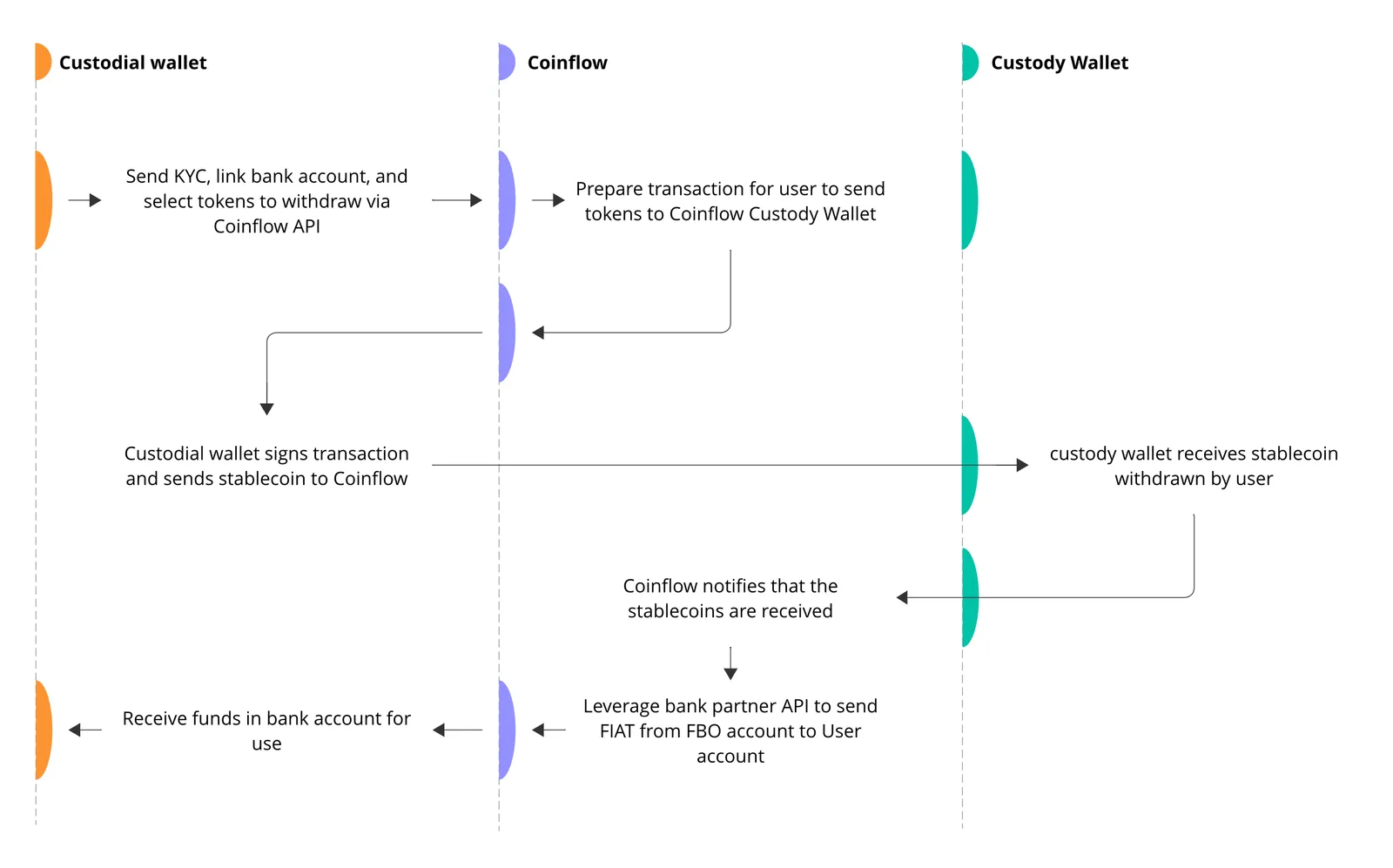
In this flow, users directly control their own crypto wallets and initiate payouts themselves. Coinflow facilitates the off-ramp by converting their stablecoins to local currency.
How It Works
- User connects their wallet to your platform
- User initiates withdrawal through Coinflow’s UI or your integration
- User signs transaction from their wallet
- Funds transfer from user’s wallet to Coinflow
- Coinflow processes fiat payout to user’s bank account/card
- User receives funds in their selected payout destination
Flow of Funds
When to Use This Flow
- DeFi applications - Where users control their own wallets
- Web3 gaming - Where in-game assets are on-chain NFTs
- Crypto-native platforms - Where users are comfortable with wallets
- Decentralized marketplaces - Where users have custody of their funds
Implementation Options
Option 1: Using Coinflow’s React SDK
Advantages:
- Pre-built UI components
- Handles KYC flow
- Manages bank authentication
- Fastest implementation
Option 2: Using Coinflow’s API
Advantages:
- Full control over UX
- Custom integration
- Mobile app support
Key Considerations
- User Identification: Uses wallet addresses (not user IDs)
- KYC Required: Each user must complete verification before their first payout
- Wallet Requirements:
- User must have USDC/EUROe balance
- User must have gas fees (or use gasless transactions)
- Wallet must support message signing
- Supported Blockchains: Solana, Ethereum, Base, Polygon, Arbitrum, Stellar
- Gas Fees: Users pay gas (or you can enable gasless transactions)
Gasless Transactions
Coinflow supports gasless withdrawals for USDC on EVM chains, where users don’t need ETH/MATIC for gas. Learn more →
Next Steps
- Choose your implementation method (SDK or API)
- Follow the implementation guide
- Configure KYC and bank authentication
- Test in sandbox environment